
informational 6 min read
Burj Khalifa Construction: How the Tower Was Built
Updated October 27, 2026
TL;DR: Burj Khalifa was built from January 2004 to its opening on 4 January 2010 by Samsung C&T, BESIX and Arabtec, to a design by Skidmore, Owings & Merrill. It stands on 192 deep concrete piles in weak rock, its concrete core was pumped to a record 606 m and poured at night with ice in summer, and its steel spire was assembled inside the tower and jacked into place. About 7,500 skilled workers, mostly from South and East Asia, were on site at the peak.
How were the foundations built in desert ground?
The tower rests on 192 piles driven deep into weak rock, under a thick concrete raft. In 2003, 33 test holes drilled down to 140 m found “weak to very weak sandstone and siltstone” just metres below the surface, in what the study called a seismically active area. The answer was a deep pile foundation.
The numbers, from Wikipedia:
- 192 piles, each 1.5 m in diameter and 43 m long, buried more than 50 m deep.
- 45,000+ m³ of concrete, weighing more than 110,000 tonnes, in the foundation.
- About 450,000 tonnes: the total building weight the foundation was designed to carry.
- A cathodic protection system under the concrete to stop the salty, sulphate-rich groundwater from corroding the steel.
Excavation began in January 2004 and piling in February 2004. The structure began to rise in March 2005.
How did they pump concrete so high?
They pumped it with a pump built for the job and poured it at night. Putzmeister created a new high-pressure trailer pump, the BSA 14000 SHP-D, for the tower. On 13 May 2007 it set a record for vertical concrete pumping on a building at 452 m, and it went on to deliver concrete to 606 m, the 156th floor. The Skyscraper Museum notes the concrete was cast with a jump-form system that climbed with the core.
Heat was the other problem. Gulf temperatures can reach 50 °C, and concrete that sets too fast cracks. So in summer the crews added ice to the mix and poured at night, when the air was cooler and more humid. Each batch was tested, and CTLGroup ran creep and shrinkage tests for SOM.
In all, the tower used 330,000 m³ of concrete and 55,000 tonnes of steel rebar, over 22 million man-hours. The design uses the bundled tube idea of Fazlur Rahman Khan, which Wikipedia says let it use about half the steel of the Empire State Building, proportionally. Its 27 setbacks, spiralling up the Y-shaped plan, were shaped to calm the wind. The milestones came fast: level 50 in June 2006, past Taipei 101 as the world’s tallest building on 21 July 2007, and topped out at 829.8 m on 17 January 2009. More numbers are in Burj Khalifa facts.
Who built Burj Khalifa?
Samsung C&T of South Korea built Burj Khalifa, in a joint venture with BESIX of Belgium and Arabtec of the UAE. Wikipedia notes Samsung C&T had also worked on the Petronas Twin Towers and Taipei 101. The wider team:
| Role | Company or person |
|---|---|
| Developer and owner | Emaar Properties |
| Architect and structural engineer | Skidmore, Owings & Merrill (Adrian Smith, chief architect; Bill Baker, structural engineer) |
| Main contractor | Samsung C&T, with BESIX and Arabtec |
| Project manager | Turner |
| Supervising engineer | Hyder Consulting |
| Architecture supervision | NORR Group |
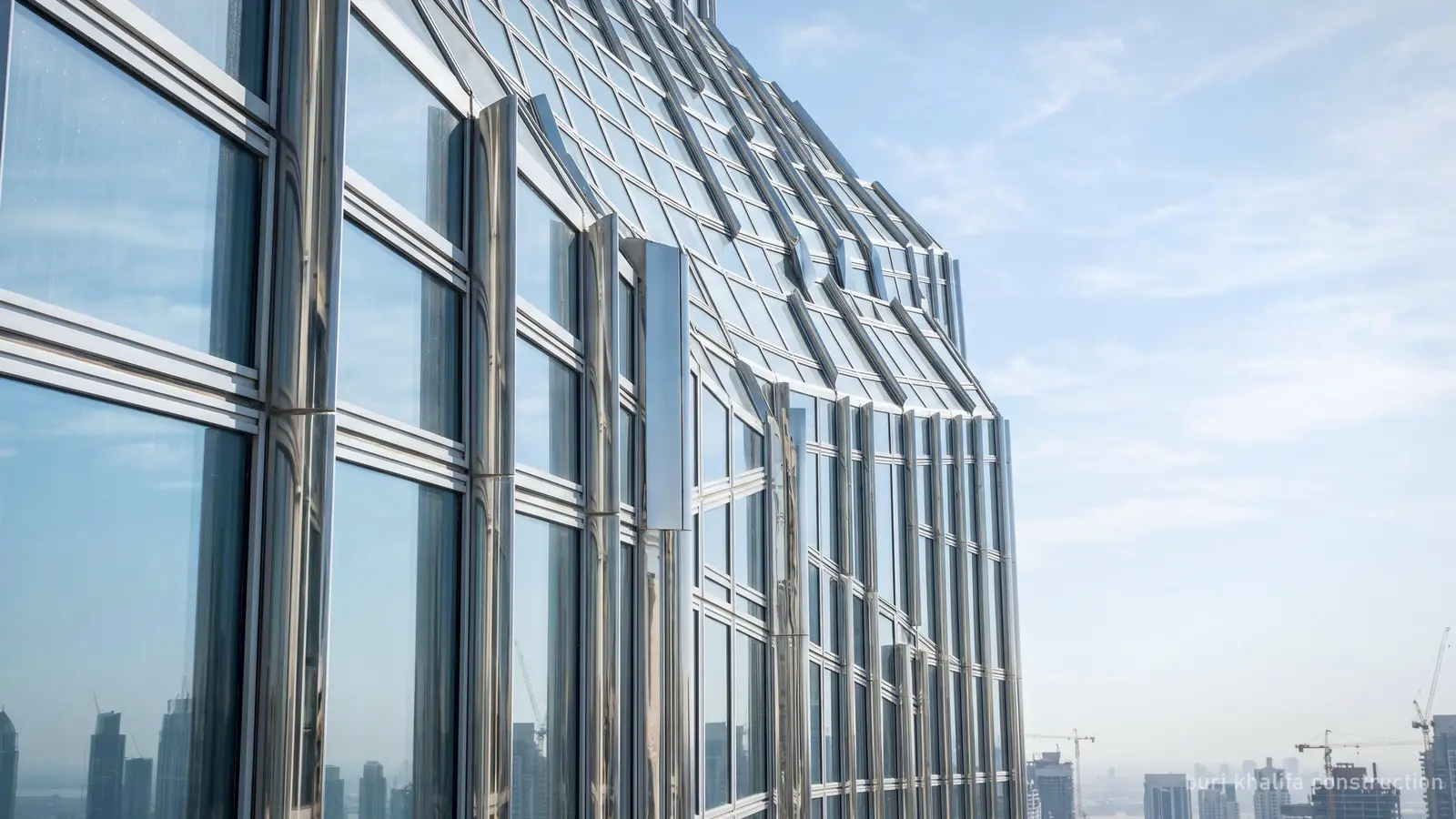
| Exterior cladding | Far East Aluminium |
Some of the steel came from far away. More than 35,000 tonnes of structural steel came from the Palace of the Republic in Berlin, East Germany’s old parliament, shipped to Dubai after its demolition in 2008. For who drew it, see who designed Burj Khalifa; for who owns it, who owns Burj Khalifa.
How was the spire lifted into place?
The spire was built inside the tower and pushed up from within. The Skyscraper Museum describes it: the top section, a steel pipe weighing 350 tons, was assembled from more than 20 welded sections inside the building, then jacked hydraulically into its final position over eight separate lifts, using three hydraulic strand jacks and a series of roller guides. Above level 156, the steel frame was lifted by a crane and derrick fixed to the concrete core.
Wikipedia gives the finished spire as more than 4,000 tonnes of structural steel, with a central pinnacle pipe of 350 tonnes and 200 m. The spire is 244 m tall in all and holds communications equipment. The tower topped out on 17 January 2009, Emaar announced the exterior complete on 1 October 2009, and it opened on 4 January 2010.
Who were the workers, and what were conditions like?
Most of the workers came from South and East Asia, and their pay and housing drew wide criticism. On 17 June 2008 about 7,500 skilled workers were on site. Press reports in 2006 said skilled carpenters earned £4.34 a day and labourers £2.84. A BBC investigation and a Human Rights Watch report described poor housing, long hours and low pay, and Wikipedia notes complaints that some workers had their passports taken.
In March 2006 about 2,500 workers rioted over late buses at the end of their shifts, causing almost £500,000 in damage. One construction-related death was reported during the build, though Human Rights Watch noted that workplace deaths in the UAE are poorly documented.
You can see the story of the build in the tower itself: the SKY level 148 and Lounge listings both mention a ground-floor exhibition on the construction. The levels 124 and 125 ticket starts from $51 (AED 189) at 1 USD = 3.6725 AED and shows 4.3 on 92,917 reviews of that ticket on GetYourGuide. Every option is on the Burj Khalifa tickets page.
Check prices & dates
Book your tickets in advance: popular time slots sell out.
Book Burj Khalifa Tickets
From$51per person
Check availability- Free cancellation up to 24h
- Pick your date and time slot
- Prices in US dollars
Price checked Oct 27, 2026
Frequently asked questions
Who built Burj Khalifa?
Samsung C&T of South Korea was the main contractor, in a joint venture with BESIX of Belgium and Arabtec of the UAE. Skidmore, Owings & Merrill designed it, and Emaar Properties developed and owns it.
Did Samsung build the Burj Khalifa?
Yes. Samsung C&T, the construction arm, led the joint venture that built it. Wikipedia notes the same firm also worked on the Petronas Twin Towers and Taipei 101.
How long did it take to build Burj Khalifa?
About six years. Excavation began in January 2004, the tower topped out at 829.8 m on 17 January 2009, the exterior was finished on 1 October 2009 and it opened on 4 January 2010.
How deep are the foundations of Burj Khalifa?
The tower stands on 192 piles, each 1.5 m wide and 43 m long, buried more than 50 m deep, under a foundation of more than 45,000 m³ of concrete.
How many workers built Burj Khalifa?
About 7,500 skilled workers were on site in June 2008, according to Wikipedia, mostly from South and East Asia. Construction took 22 million man-hours.
Why was Burj Khalifa built?
Wikipedia says the decision was reportedly tied to the government's plan to move Dubai's economy from oil towards services and tourism, with the tower as the centrepiece of Downtown Dubai.
Sources